

AI Search for Medical Practices: What to Measure Now
How to connect search visibility, website traffic, and booked consultations as AI changes the search experience.

A prospective LASIK patient might ask Google about recovery, read an AI-generated summary, and leave without visiting a practice website. That person could return later to search for a surgeon by name, compare local practices, or book a consultation. A traffic report captures only part of that possible journey.
AI search for medical practices raises a practical question: Is your marketing helping people choose your practice, and can you measure what happens after they discover it?
Research shows that AI summaries can be associated with fewer clicks to traditional search results. The size of that effect varies across studies. For ophthalmology, dental, and other elective-care practices, the useful response is to connect search performance with inquiries, consultations, and patient acquisition.
What the research says about AI answers and clicks
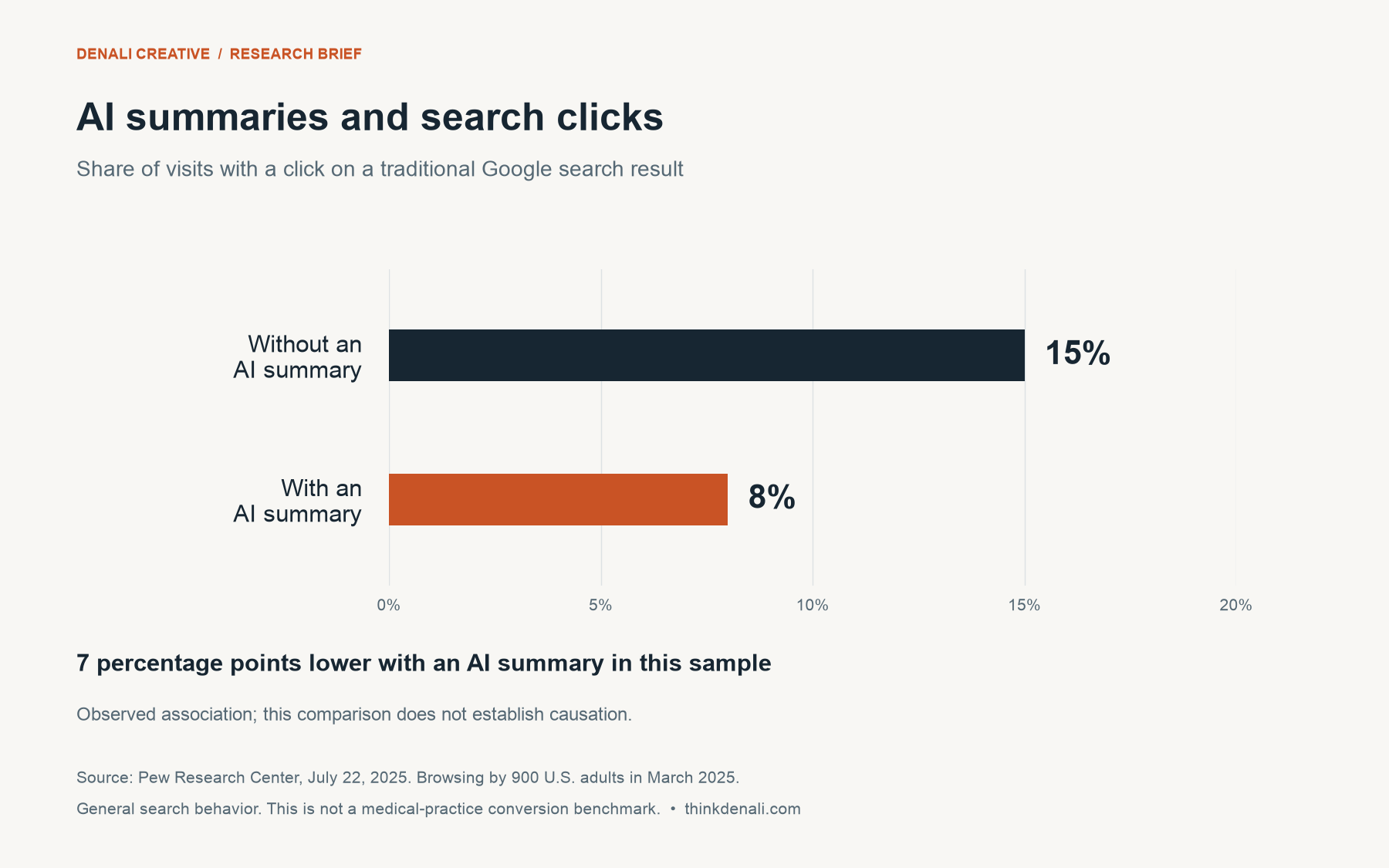
Pew Research Center analyzed browsing activity from 900 U.S. adults in March 2025. When an AI summary appeared, users clicked a traditional search result in 8% of visits, compared with 15% when no summary appeared. That is a seven-percentage-point gap. The study observed user behavior; it did not establish that AI summaries alone caused the difference. Read Pew’s study.
Ahrefs approached the question differently. Its February 2026 research update compared desktop click-through rates across 300,000 keywords, using December 2023 and December 2025 data. It estimated a 58% lower click-through rate for the first organic result on AI Overview queries relative to its modeled comparison. This was an update to a study, not a measurement of a particular 2026 Google algorithm update. Read the Ahrefs methodology.
The direction has not been uniform. Seer’s April 2026 report, using an expanded dataset, found that organic click-through rates for queries classified as having AI Overviews rose from 1.3% in December 2025 to 2.4% in February 2026. Its broader sample and changed methodology limit direct comparison with its earlier studies. The recovery also covered only two months. Read Seer’s update.
These studies support monitoring changes in click behavior. They do not establish that your practice will lose a particular percentage of traffic, consultations, or revenue.
AI search for medical practices still depends on strong SEO
Google says its AI Overviews and AI Mode may run multiple related searches to assemble a response. It also says established SEO practices remain relevant, and there are no additional technical requirements for appearing in these features. Pages must be indexed and eligible to appear with a search snippet; meeting those conditions does not guarantee inclusion. Google’s guidance on AI features.
For a practice, that makes the fundamentals worth protecting: accessible pages, clear descriptions of services, accurate provider information, and useful answers to real patient questions.
Answer engine optimization, or AEO, adds attention to whether AI-generated answers mention or cite your practice. It belongs alongside your existing medical SEO strategy. A citation can create exposure, but it does not by itself demonstrate a new patient inquiry.
Local visibility also deserves its own attention. Google identifies relevance, distance, and prominence as the main factors behind local rankings, and recommends keeping Business Profile information complete and accurate. Confirm your locations, hours, contact details, and business categories before assuming a traffic change requires an entirely new strategy. Google’s local ranking guidance.
Measure the path from discovery to a consultation
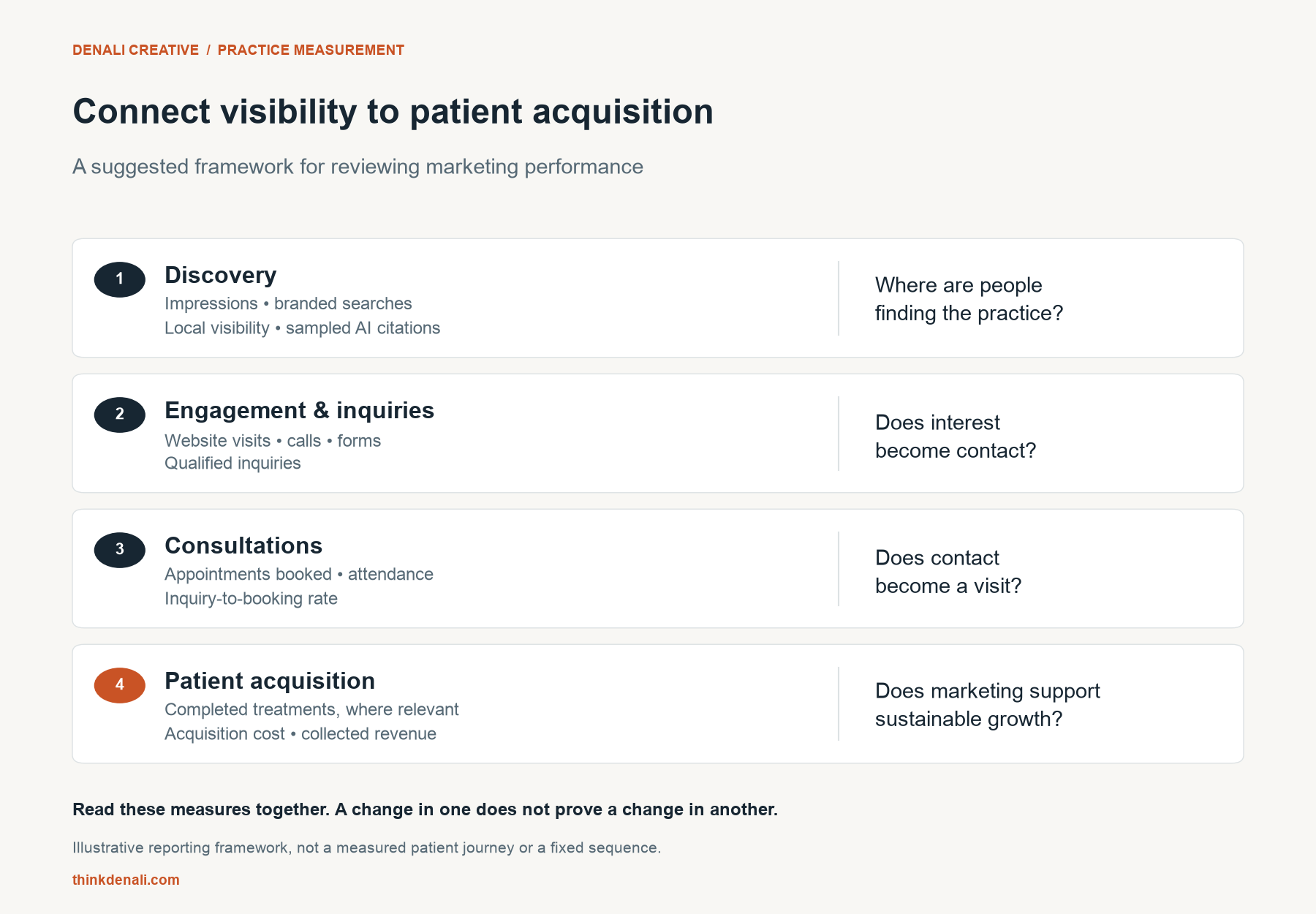
Keep rankings and website traffic in your reports, and connect them to what happens next. A useful practice dashboard answers four separate questions:
| Measurement area | What to track | What it helps you understand |
|---|---|---|
| Discovery | Search impressions, branded searches, local visibility, and sampled AI mentions or citations | Where the practice is appearing |
| Engagement and inquiries | Website visits, calls, forms, and qualified inquiries | Whether interest becomes contact |
| Consultations | Appointments booked, attendance, and inquiry-to-booking rate | Whether the team is converting inquiries into visits |
| Patient acquisition | Completed treatments where relevant, cost per acquired patient, and collected revenue | Whether marketing supports sustainable practice growth |
Define a qualified inquiry consistently. A request about a service you offer is different from a wrong number, a job inquiry, or an existing patient’s administrative call.
Also separate click-through rate from total clicks. CTR is clicks divided by impressions. If impressions rise while clicks stay flat, CTR falls—even though the number of clicks has not declined. Review both numbers before interpreting the change.
Add a brief intake question about where the person first heard of the practice. Use those responses alongside digital reporting. They can reveal influences your website reports miss, but people’s recollections will not provide perfect attribution.
For AI visibility checks, record the exact question, platform, date, and relevant location. Treat those checks as a sample of possible answers, not a complete count of what every prospective patient sees.
Build content that helps people evaluate your practice
The strongest editorial starting point is the information your team is qualified to explain. Google emphasizes original value, clear sourcing, and evidence of expertise in its guidance for helpful content. It also cautions against changing dates merely to make pages appear fresh. Google’s content guidance.
For a medical practice, we recommend focusing on:
- Specific patient questions. Explain what a consultation involves, how to prepare, and which questions the patient should bring. Have an appropriate clinician review medical explanations before publication.
- Visible expertise. Identify the author and, when applicable, the clinical reviewer. Link to accurate credentials and relevant source material.
- Practice-specific information. Describe the services, locations, consultation process, and pricing or financing details your practice can substantiate.
- Useful formats. Pair clear written explanations with doctor-led videos, diagrams, or checklists when they help the reader understand.
- Meaningful updates. Revise content when evidence, services, or processes change. Make the review date reflect a real review.
Keep clinical explanations appropriately qualified. Educational content should help someone prepare for a conversation with a clinician; individual eligibility and treatment recommendations require an appropriate evaluation.
Start with a focused 30-day review
Begin with your own data before changing budgets based on an industry headline.
Week one: establish a baseline. Review recent search impressions, clicks, inquiries, and consultation bookings. Compare with the same period last year where data is available, and account for changes in advertising, staffing, services, and appointment capacity.
Week two: separate search intent. Group branded searches, general educational questions, and procedure-plus-location searches. A drop in visits to a broad educational article calls for a different investigation from a drop in consultation requests.
Week three: improve the pages closest to a decision. Check provider biographies, location pages, procedure information, contact options, and appointment forms. Make the next step clear and test that inquiries reach the right team.
Week four: review outcomes together. Have marketing and front-desk leaders examine inquiry quality, response times, bookings, and attendance. Decide what to test next, and define how you will judge the result.
The goal is a clearer connection between visibility and practice growth. AI search is one part of that work. Your content, local presence, website experience, and response to inquiries all deserve attention.
Denali Creative helps medical practices connect search strategy with conversion optimization.
Research reviewed September 17, 2026. This article was prompted by Neil Patel’s discussion of AI search and website traffic; statistics are attributed to the original research above.