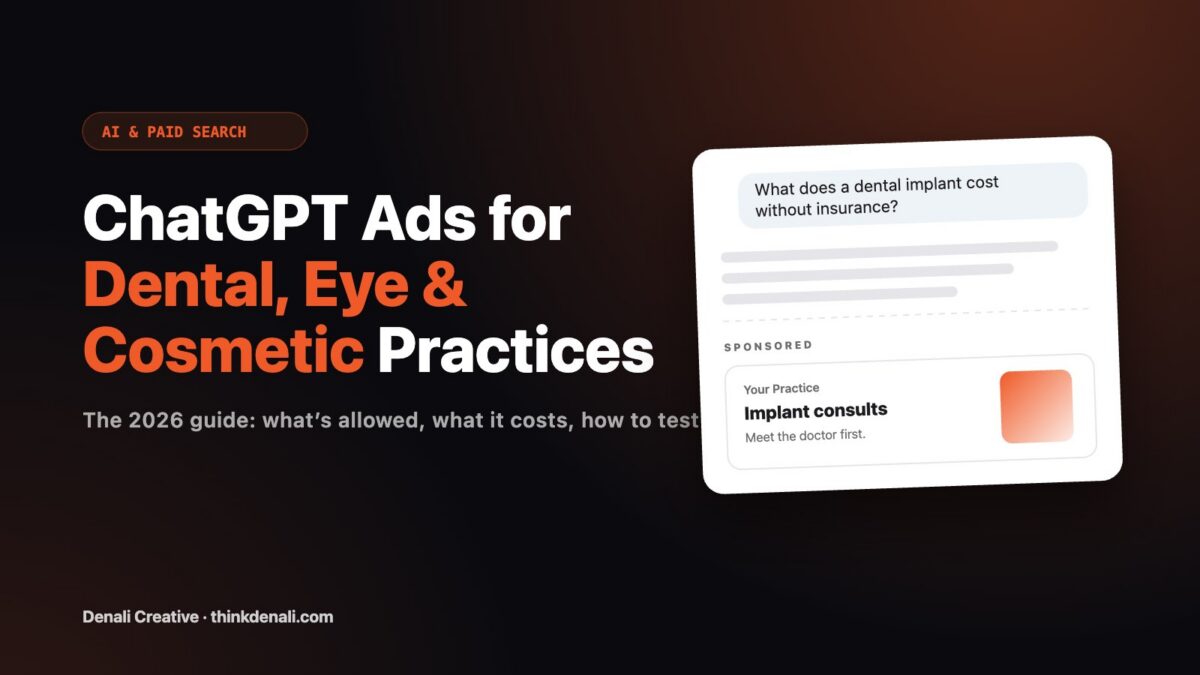
OpenAI now lets U.S. dental, vision and minimally invasive cosmetic practices advertise in ChatGPT. What is allowed by specialty, what it costs, what Ads Manager setup looks like, how to run custom ads by service, and a 30-day test plan.
A complete dental phone training for front desk teams: conversion benchmarks, the first 30 seconds, the three caller types, the dual alternative close, pricing and out-of-network scripts, and the five-minute rule for web leads.
COPE Is Tightening CE Attendance Reporting in 2027
August 25, 2026Paul M. Stubenbordt6 min read
Starting January 1, 2027, every COPE Administrator and Accredited Provider will have to submit attendance records for COPE Accredited Continuing Education within 30 days of the activity. If your organization hosts optometric CE, the reporting step you may have handled loosely — or late — becomes a hard deadline attached to every course you run.
The change comes from ARBO, the Association of Regulatory Boards of Optometry, which oversees COPE. Under the updated policy, COPE will maintain attendance records on behalf of optometric learners and ARBO’s member licensing boards through the OE TRACKER system. In practice, that means the record of who attended your course stops living in your registration spreadsheet and starts living in a database that state boards can audit against.
For most providers this is not a heavy lift. But it does mean the person who currently reconciles sign-in sheets three months after a meeting needs a new process — and needs it before your first 2027 activity, not after it.
What Actually Changes
One sentence carries the whole policy: attendance records for all COPE Accredited CE must be submitted within 30 days of the activity taking place. There is no distinction drawn between a one-hour lunch-and-learn and a three-day annual meeting. The clock starts when the activity happens.
ARBO’s stated reason is auditing. Member licensing boards verify CE at renewal, and they can only do that cleanly if attendance data is complete, electronic, and current. Records that arrive months late — or arrive as a PDF in someone’s inbox — force boards to chase individual doctors for proof. Keeping everything in OE TRACKER moves that burden off the learner and off the board, and onto the provider’s reporting workflow.
The record of who attended your course stops being your paperwork and starts being the board’s source of truth.
Your Two Submission Options
COPE Administrators and Providers can meet the requirement one of two ways. Most organizations will end up using both, depending on the format of the activity.
Option 1: Pre-formatted Excel upload
ARBO provides pre-formatted Excel spreadsheets with detailed instructions built into the file. You download the template, complete it with your attendance data, and submit it through the COPE Attendance Upload Form. The same templates are available inside your COPE Administrator account, so you don’t have to hunt for the current version.
One detail providers routinely miss: many COPE accredited activities also include Non-COPE CE. Those records are submitted separately, through the Non-COPE Attendance Upload Form. If your annual meeting mixes COPE accredited lectures with practice-management or vendor sessions, you are filing two uploads, not one.
Option 2: The OE TRACKER Mobile App
The lower-friction path is course-specific QR codes. You generate a QR code for each COPE accredited course from your Administrator/Provider account, display or distribute it at the activity, and attendees scan it with the OE TRACKER Mobile App. Attendance posts to OE TRACKER as doctors scan, which means the 30-day requirement is effectively satisfied while the course is still in the room.
The tradeoff is preparation. QR codes have to be generated per course ahead of time, printed or projected where people will actually see them, and paired with a fallback for the doctors who haven’t installed the app. ARBO publishes instructions for both administrators and optometric learners — worth sending to your attendee list in advance rather than explaining it at the podium.
What to put in place before your first 2027 activity
Name an owner. One person is accountable for submitting attendance within 30 days — not “the meeting team.”
Pick a default method per activity type. QR codes for live meetings, Excel upload for webinars and hybrid sessions is a reasonable split.
Confirm your Administrator account access. Templates and QR code generation both live behind that login. Verify who on your staff can actually get in.
Audit your data capture now. The Excel template requires specific learner identifiers. If your registration form doesn’t collect them, fix the form before January.
Separate COPE from Non-COPE on your agenda. The two upload paths are different. Tag sessions at the planning stage so nobody is sorting it out later.
Add a 30-day task to your post-event checklist. Same list as your speaker thank-yous and your evaluation summary.
Why This Matters Beyond Compliance
If you host CE, your accreditation is part of your reputation. Optometrists choose meetings partly on whether the credit is going to show up correctly on their record. A provider whose attendance reliably posts to OE TRACKER within days — rather than one that generates renewal-season phone calls from doctors who can’t find their credit — is a provider doctors come back to.
There’s a practical marketing angle too. If you’re promoting a 2027 CE event, the QR code workflow is something to communicate on the registration page and in your confirmation emails, not something to spring on attendees at check-in. “Download the OE TRACKER app before you arrive” belongs in the pre-event sequence alongside parking and the agenda.
Questions About Your Specific Situation
ARBO has pointed providers to a direct contact for policy questions: Sierra Powell, Manager of Accreditation Services, at [email protected]. If your activity format is unusual — multi-day meetings, satellite sessions, on-demand content, or courses co-hosted with another provider — that’s the conversation to have now, while there’s still runway before the effective date.
Frequently Asked Questions
When does the new COPE attendance policy take effect?
January 1, 2027. From that date, COPE Administrators and Accredited Providers must submit attendance records for all COPE Accredited CE within 30 days of the activity taking place.
How do providers submit COPE attendance records?
Two ways. You can download ARBO’s pre-formatted Excel spreadsheet, complete it, and submit it through the COPE Attendance Upload Form — the templates are also available inside your COPE Administrator account. Or you can generate course-specific QR codes in your Administrator/Provider account and have attendees scan them with the OE TRACKER Mobile App.
What about Non-COPE CE offered at the same event?
Non-COPE attendance records are submitted separately, using the Non-COPE Attendance Upload Form. Many providers offer both at a single accredited activity, which means two separate submissions.
Why is ARBO making this change?
To keep optometric learner attendance data maintained electronically within the OE TRACKER database, so ARBO’s member licensing boards receive complete, accurate CE attendance reporting to support their CE auditing.
Who should we contact with questions?
Sierra Powell, Manager of Accreditation Services at ARBO, at [email protected].
Planning a 2027 CE event?
We build registration pages, attendee email sequences, and event marketing for ophthalmic and optometric organizations — including the pre-event communication that makes new attendance workflows land smoothly.
The 4 Biggest Mistakes Practices Make Hiring a Refractive Coordinator
July 24, 2026Paul M. Stubenbordt9 min read
Your refractive coordinator is the highest-leverage hire in your practice. Not your associate surgeon. Not your marketing agency. The person who sits across from a patient after the workup and helps them decide whether to move forward with surgery. When refractive volume is stuck, the coordinator seat is usually the reason — and the hiring process that filled that seat is usually where it went wrong.
I learned this the hard way — and then the profitable way. Early in my career, working as a refractive coordinator myself, I helped take a practice from roughly 20 refractive cases a month to 127 in 60 days. Same surgeon. Same lasers. Same ad budget. The variable was what happened in the consult room and on the phone. Twenty-plus years later, working with refractive practices across the country, the pattern hasn’t changed.
Here are the four mistakes I see over and over — and how to avoid every one of them.
Mistake #1: Hiring for Experience Instead of Personality
The most common line in a refractive coordinator job post is “2+ years of refractive experience required.” It feels safe. It’s also the fastest way to inherit someone else’s mediocre performer.
Here’s the uncomfortable truth: a coordinator with five years of experience and a 30% conversion rate will give you… a 30% conversion rate. Experience tells you they know the terminology. It tells you nothing about whether patients trust them, like them, and say yes to them.
You can teach anyone LASIK, EVO ICL, and lens options in a few weeks. You cannot teach warmth, drive, or the instinct to ask for the decision.
Hire for personality. Train for everything else.
Mistake #2: Treating the Role Like a Scheduling Job
Look at how the position is written up in most practices: answer phones, book consults, verify benefits, hand out financing brochures. That’s an administrative job description for what is fundamentally a sales role — and if you staff it like admin, you’ll get admin results.
A great refractive coordinator owns a number: consults-to-surgery conversion. They follow up with every patient who “wants to think about it.” They know how to present fees with confidence instead of sliding a sheet across the desk and apologizing. If the person in that seat doesn’t see themselves as responsible for surgical volume, no amount of refractive marketing spend will fix your conversion problem — you’ll just pay more per consult to lose the same percentage of them.
Mistake #3: A Compensation Plan With No Skin in the Game
If your coordinator makes exactly the same money whether the practice does 15 cases or 50, don’t be surprised when the pipeline coasts. Flat salary attracts people who want a flat job.
The practices that consistently convert pair a fair base with a performance bonus tied to booked-and-completed surgeries. The balance matters:
Too little upside and it changes nothing about behavior.
Too much upside and you attract pressure-sellers who damage your reputation and your reviews.
Structured correctly, the bonus funds itself many times over out of cases that would otherwise have walked out the door “to think about it” forever.
Mistake #4: No Objective Way to Evaluate Candidates
Most refractive coordinator hires come down to a gut-feel interview: “She seemed nice. He knew the lingo.” Then, six months later, when volume is flat, the practice blames the leads, the website, or the market — everything except the hire, because there was never a standard to measure the hire against.
Every candidate should be measured against the same bar, using questions that surface evidence instead of rehearsed answers:
Tell me about a time you changed someone’s mind about a big decision.
Walk me through how you’d follow up with a patient who said they need to think about it.
How comfortable are you discussing a $6,000 fee — show me how you’d present it.
Tell me about a goal you hit that nobody made you set.
This is why we built a weighted scorecard for the role. It scores candidates across the competencies that actually predict conversion — communication warmth, resilience, follow-up discipline, comfort discussing money — flags the non-negotiable traits, and turns “she seemed nice” into a number you can compare across candidates. It works just as well as an honest audit of your current coordinator.
Free Download: The Refractive Coordinator Hiring Scorecard
The exact weighted scorecard we use to evaluate coordinator candidates — 8 weighted competencies, non-negotiable trait flags, and evidence-based interview prompts. Print it, score every candidate against the same standard, and stop hiring on gut feel.
Refractive surgery is elective. Patients don’t need it — they need to be guided to it by someone they trust. That makes the coordinator seat the single biggest multiplier (or bottleneck) on every marketing dollar you spend.
Hire for personality. Define the role as sales. Pay for performance. Measure against a standard. Get those four right and the same ad budget starts producing dramatically different surgical volume.
If you’d rather not run the search alone, Denali Recruiting helps refractive practices find and vet coordinator candidates — and our refractive sales training gets the right hire converting fast.
Frequently Asked Questions
What does a refractive coordinator do?
A refractive coordinator guides prospective patients from initial inquiry through their decision about elective vision correction surgery such as LASIK, EVO ICL, or refractive lens exchange. The role includes phone and consultation conversations, explaining procedures and fees, presenting financing, following up with undecided patients, and coordinating the path to surgery. In a well-run practice it is fundamentally a patient-facing sales and conversion role, not an administrative scheduling position.
Should a refractive coordinator have prior ophthalmology experience?
It helps less than most practices assume. Procedure knowledge, terminology, and workflow can be taught to a strong communicator in a matter of weeks. The traits that actually predict conversion — warmth, resilience, follow-up discipline, and comfort discussing money — cannot be trained into someone who lacks them. Hiring on experience alone often means inheriting another practice’s average performer along with their habits.
How should a refractive coordinator be paid?
The most effective structures pair a fair base salary with a performance bonus tied to booked-and-completed surgeries. The bonus should be meaningful enough to reward conversion but not so dominant that it encourages pressure tactics that damage patient trust and reviews. Structured correctly, the incentive pays for itself out of cases that would otherwise have been lost to indecision.
How do I evaluate refractive coordinator candidates objectively?
Use a weighted scorecard instead of gut feel. Score every candidate against the same set of competencies — communication warmth, drive, resilience, follow-up discipline, comfort presenting fees — using evidence-based interview questions that ask for real examples rather than rehearsed answers. Flag non-negotiable traits separately, and require the same process for internal candidates and referrals as for outside applicants.
What conversion rate should a refractive coordinator achieve?
Benchmarks vary by market, procedure mix, and how consultations are counted, so the more useful discipline is measuring your own consult-to-surgery conversion consistently and tracking the trend. A practice that tracks the number can diagnose whether a volume problem is a lead problem or a conversion problem. A practice that doesn’t track it usually blames marketing by default — and keeps paying more per consult to lose the same percentage of them.
Get the Refractive Coordinator Hiring Scorecard
The weighted scorecard, non-negotiable trait flags, and evidence-based interview prompts we use to help practices hire coordinators who convert. Free download.
Artificial intelligence is changing every stage of an ophthalmology practice — how patients find you, how your phones get answered, how the doctor documents an exam, how an IOL gets selected, and how a hesitant LASIK patient finally says yes. This isn’t a prediction about the future. Every one of the ten changes below is available to practices today.
AI won’t replace your practice. But practices that use AI well are already pulling ahead of practices that don’t — answering inquiries faster, documenting faster, educating patients better, and showing up in places their competitors are invisible. Here are the ten changes that matter most, in the order a patient experiences them: from the moment they search for a surgeon to the day they’re treated.
1. AI Is How Patients Find You Now
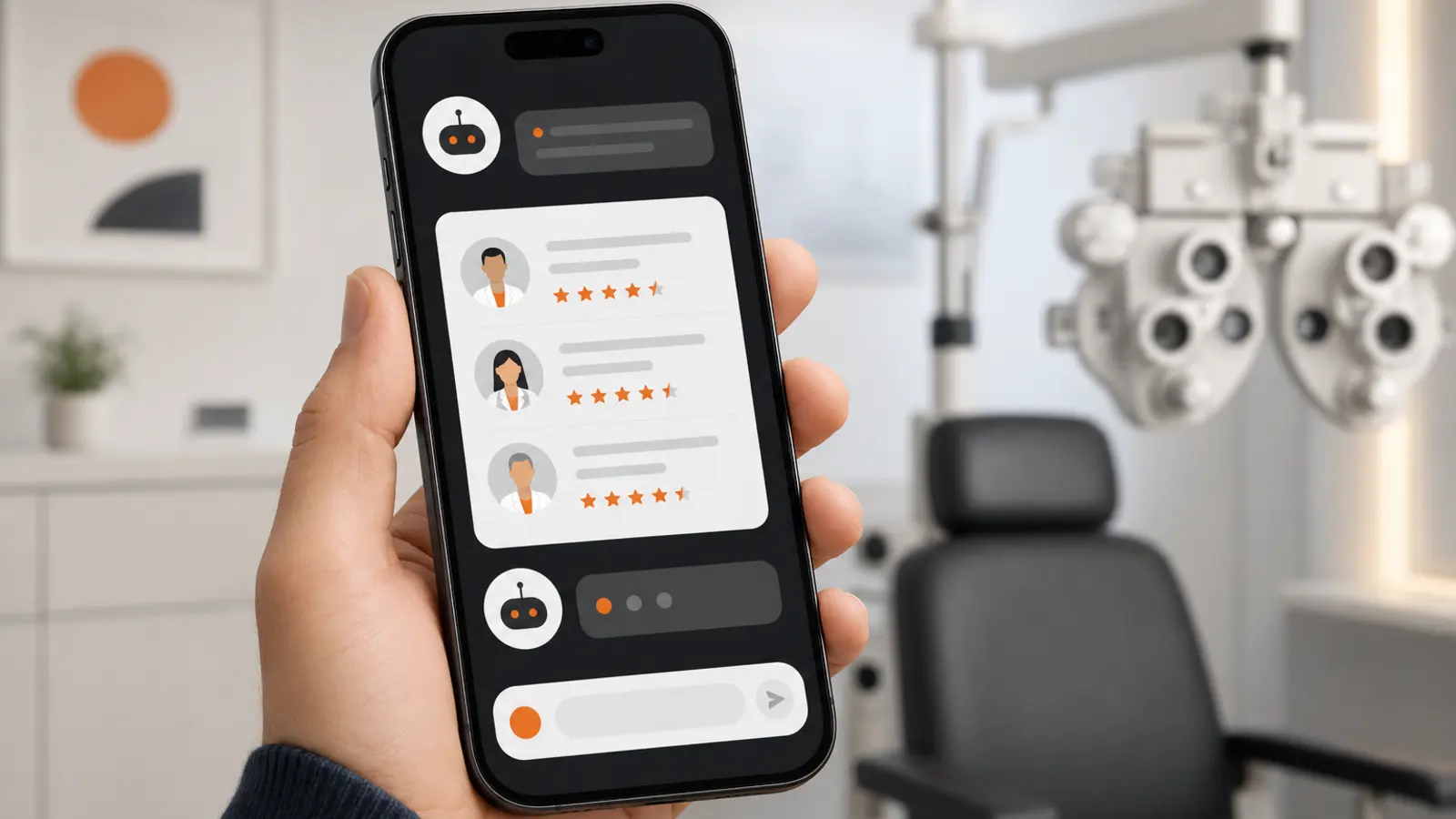
Patients aren’t only Googling “cataract surgeon near me” anymore. They’re asking ChatGPT, Gemini, Perplexity, and Google’s AI Overviews to recommend a surgeon — and getting back a short, curated list of names instead of ten blue links. If your practice isn’t part of that answer, you’re invisible at the most influential moment of the decision.
Being included isn’t luck. It’s the product of clear service pages, deep physician profiles, consistent business listings, credible third-party mentions, and a technically sound website. We covered this in depth in Why Your Practice Isn’t Showing Up in AI Search — if you read one companion piece to this article, make it that one.
The new first impression: a recommendation inside an AI answer.
2. AI Agents That Answer and Book — 24/7
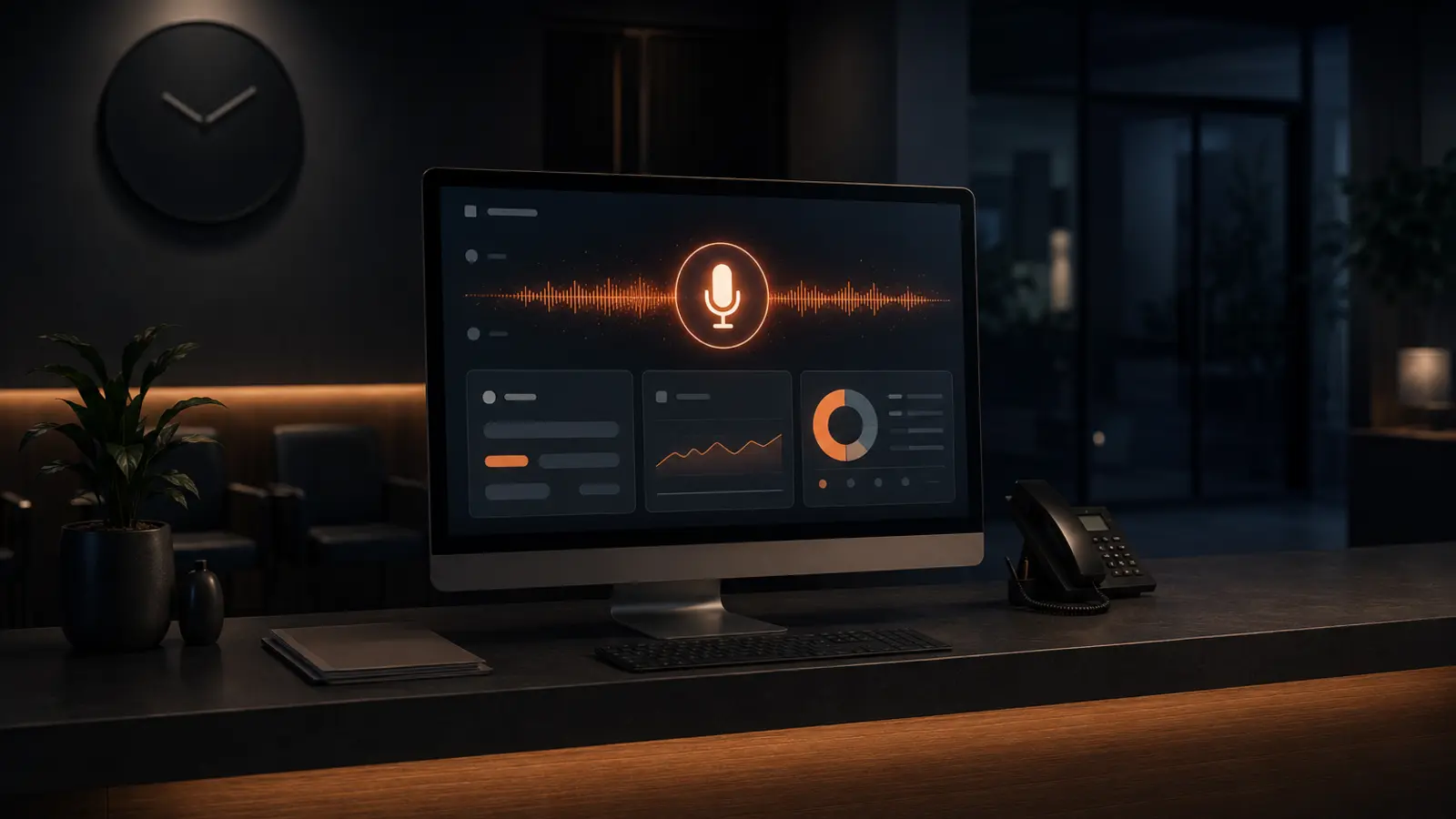
A LASIK lead that calls at 8:45pm doesn’t wait until morning. They call the next practice on the list. AI voice and chat agents change that math: they answer instantly, around the clock, handle the questions that fill your front desk’s day — “Do you take my insurance?” “How much is LASIK?” “Do you offer financing?” — and book the consultation on the spot.
The best implementations don’t replace your team; they catch what your team physically can’t: after-hours calls, overflow during clinic crunch, and the third simultaneous caller who would otherwise hit voicemail. In elective surgery, speed-to-answer is a competitive weapon, because the patient calling you is usually calling your competitors too.
3. AI Call Analysis on Every Phone Call
Most practices have no idea what happens on their phones. AI call analysis fixes that by reviewing and scoring every call: Was the caller asked for an appointment? Were premium options mentioned? Did a $6,000 LASIK inquiry get answered with a price and a shrug — or a scheduled consult?
Instead of sampling a handful of calls a month, you see conversion behavior across all of them, spot exactly which inquiries were mishandled, and know precisely what to coach. Pair the data with structured phone training and the same call volume starts producing measurably more consultations — before you spend another dollar on advertising.
The calls you miss at night are consults your competitor books in the morning.
4. Ambient AI Scribes That Give Doctors Their Day Back
Documentation is the tax on every clinic day. Ambient AI scribes listen to the natural conversation between doctor and patient and draft the note in real time — so the physician talks to the patient instead of the keyboard, and the chart is essentially done before the next patient is in the chair.
The practice-level impact compounds: more patients per template without feeling rushed, less after-hours charting, better face-to-face patient experience, and doctors who end the day less burned out. For a surgical practice, freed clinic capacity flows directly to the top of the surgical funnel.
5. AI-Assisted Diagnostics and Earlier Disease Detection
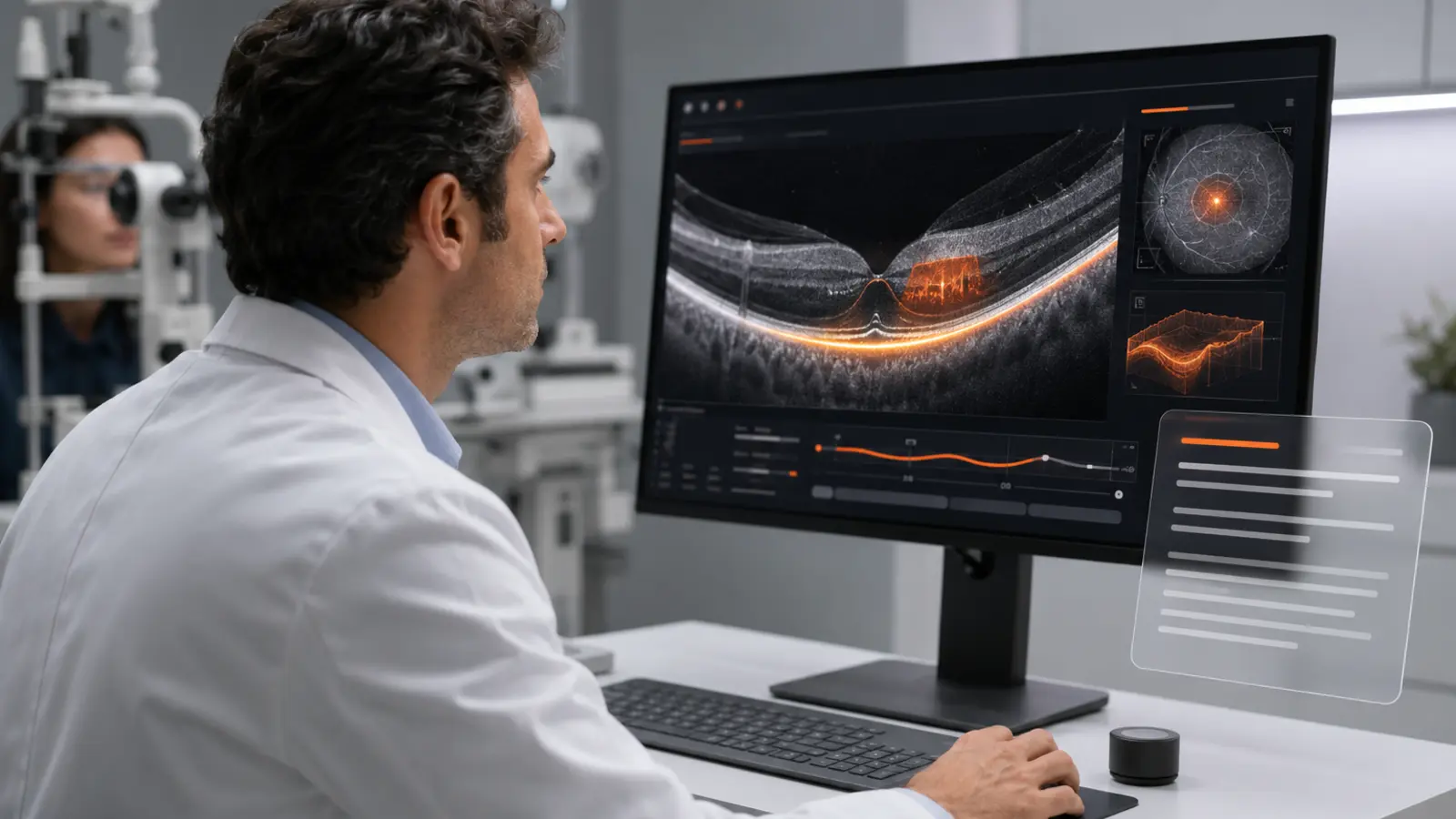
Ophthalmology is arguably the most AI-advanced specialty in medicine. FDA-cleared autonomous AI systems can screen for diabetic retinopathy from retinal images without a specialist reading each one, and AI-supported interpretation of OCT and fundus imaging helps flag glaucoma, AMD, and other pathology earlier and more consistently.
For patients, that means disease caught sooner. For the practice, it means screening programs that scale, referral relationships built on real clinical value, and earlier identification of the cataract and retina patients who will need surgical care. Clinical AI should always operate under physician oversight — but as a force multiplier for a busy practice, it’s already here.
6. Smarter IOL Selection and Surgical Planning
Refractive outcomes drive premium-lens confidence, and AI is quietly improving them. Machine-learning IOL power calculation methods and AI-assisted surgical planning tools analyze far more variables than traditional formulas, helping surgeons hit refractive targets more consistently — including in the tough eyes: post-refractive corneas, extreme axial lengths, unusual anterior segments.
Better predictability isn’t just a clinical win. It’s a commercial one: surgeons who trust their outcomes present premium lens options with more conviction, and patients hear the difference.
AI in the lane: flagged pathology, drafted notes, more time facing the patient.
7. AI Patient Education That Actually Converts
Handing a cataract patient a trifold brochure about lens options is a 1995 solution to a 2026 decision. AI-powered education tools — interactive vision simulators, avatar-based counselors, personalized video explanations — let patients see the difference between a monofocal and an extended-depth-of-focus lens, or experience what their vision could look like after LASIK, before they ever sit down with the surgeon.
A pre-educated patient is a better consultation: they arrive with realistic expectations, better questions, and far less fear. Practices using interactive education consistently report smoother conversations about premium options — because the patient isn’t hearing about them for the first time while holding a fee sheet.
Show, don’t tell: simulated vision beats a brochure every time.
8. Marketing Content and Video at Scale
The practices dominating local search and social media aren’t necessarily bigger — they publish more, and more consistently. AI-assisted production has collapsed the cost of doing that: blog articles grounded in the surgeon’s actual expertise, educational videos, social clips cut from a single filming session, email campaigns, and ad variations — produced in days, not quarters.
The critical caveat: volume without expertise is noise, and both Google and AI answer engines are getting better at ignoring it. The winning formula is the surgeon’s genuine knowledge, structured and amplified by AI, reviewed for accuracy — which is exactly how we approach video production and content for our clients. AI is the multiplier; the doctor’s expertise is the substance.
9. Predictive Scheduling, Recall, and the Revenue Hiding in Your EHR
Your next hundred cataract surgeries are probably already in your database. AI-driven recall and scheduling tools find them: the patient told “let’s watch that cataract” three years ago who never came back, the diabetic overdue for screening, the appointment slots statistically likely to no-show that can be backfilled from an automated waitlist.
This is the least glamorous item on the list and often the fastest payback, because it monetizes demand you already generated. Fewer empty slots, fuller surgical schedules, and reactivated patients who genuinely needed the care — without a single new ad dollar.
10. Reputation and Review Intelligence
Reviews now feed two audiences: prospective patients and the AI platforms deciding whether to recommend you. AI reputation tools monitor sentiment across Google, Healthgrades, and social platforms, draft timely and compliant review responses, and — most valuably — surface the patterns: if thirty reviews in six months mention hold times or a rushed checkout, that’s not a marketing problem, it’s an operations report written by your patients.
Practices that respond consistently and fix the recurring issues build exactly the kind of review profile that both patients and answer engines reward.
AI won’t replace your practice. But practices using AI will replace practices that don’t.
Where Should a Practice Start?
Not with all ten. The right sequence starts where leverage is highest and risk is lowest — the front of the funnel and the phone — then works inward toward clinical workflows.
A Practical First 90 Days
Measure first: run AI call analysis and an AI-search visibility test. You can’t fix what you haven’t seen.
Fix discoverability: strengthen the website, listings, and content so AI platforms can confidently recommend you.
Stop the leaks: add after-hours AI answering and structured phone training where the call data shows fumbles.
Then scale: layer in patient education tools, content production, recall automation, and clinical AI as workflows mature.
The common thread across all ten: AI rewards practices that were already well-run. Clear services, accurate data, trained people, and measured results give every one of these tools something to multiply.
Frequently Asked Questions
How is AI used in ophthalmology practices today?
AI is used across both the clinical and business sides of ophthalmology. Clinically, that includes FDA-cleared screening for diabetic retinopathy, AI-supported interpretation of OCT and fundus imaging, ambient AI scribes that draft exam documentation, and machine-learning IOL calculation methods. On the business side, practices use AI for search visibility, 24/7 phone and chat agents, call analysis and scoring, patient education simulators, content and video production, predictive scheduling and recall, and reputation management.
Will AI replace ophthalmologists or practice staff?
No. Clinical AI tools operate under physician oversight and act as force multipliers, not replacements — flagging pathology, drafting documentation, and improving calculation accuracy while the doctor makes the decisions. On the business side, AI agents catch the calls and inquiries a human team physically can’t, such as after-hours and overflow, rather than eliminating front-desk roles. The realistic risk isn’t AI replacing a practice; it’s competitors using AI to out-answer, out-publish, and out-convert a practice that doesn’t.
What is the best first AI investment for an ophthalmology practice?
Start with measurement: AI call analysis and an AI-search visibility test. Call analysis shows exactly how many inquiries your practice already generates and how many are being lost on the phone, and a visibility test shows whether platforms like ChatGPT and Google AI Overviews recommend you. Both reveal high-return fixes — after-hours answering, phone training, website and listing improvements — that recover revenue from demand you already have before you spend more on advertising.
Does AI help an ophthalmology practice get more patients?
Yes, in several compounding ways. AI search visibility puts the practice inside the recommendations patients now ask for. AI agents answer and book inquiries instantly, including after hours. Call analysis and phone training raise the percentage of inquiries that become consultations. Patient education tools improve consult-to-surgery conversion. And recall automation reactivates patients already in the practice’s database who are due or overdue for care.
Is AI-generated content safe to publish on a medical practice website?
Only with expert oversight. Search engines and AI answer platforms increasingly reward content that demonstrates genuine, verifiable expertise and ignore generic mass-produced material. The safe and effective approach is using AI to structure and scale the surgeon’s actual knowledge, with every piece medically reviewed for accuracy and free of guarantees or unsupported claims. AI is the production multiplier; the physician’s expertise is the substance.
How much does it cost to bring AI into an ophthalmology practice?
It varies widely by tool, from modest monthly software subscriptions for call analysis, chat agents, or reputation monitoring to larger investments in clinical systems and website rebuilds. The more useful framing is payback: tools that recover missed calls, reactivate dormant patients, or lift consultation conversion typically pay for themselves out of cases that would otherwise have been lost. A phased 90-day rollout lets a practice fund later phases from the returns of earlier ones.
The Practices That Move First Get Named First
Every change in this article shares one trait: it compounds. The practice that starts answering every call today has six months of recovered leads by January. The practice that builds AI-search visibility now gets recommended while competitors are still debating whether AI matters. Waiting doesn’t preserve the status quo — it hands the advantage to whoever moves first in your market.
We’ll assess your AI-search visibility, your phone conversion, and your patient acquisition funnel — and show you which of these ten changes would pay back fastest in your market.
Why Your Practice Isn't Showing Up in AI Search — and What to Do About It
July 12, 2026Paul M. Stubenbordt14 min read
AI search has changed how patients find doctors. They are no longer relying exclusively on Google to choose a physician, dentist or elective healthcare provider — they're asking ChatGPT, Google AI Overviews, Gemini, Perplexity, Copilot and Claude. If your practice isn't part of the answer, you may be invisible at the single most influential moment in the patient's decision.
Instead of a page of ten blue links, patients now receive a direct, conversational answer containing a short list of recommended providers. The AI may compare physicians, summarize their qualifications and explain why one practice is a good fit. Patients are asking questions like:
Who is the best LASIK surgeon near me?
Which cataract surgeon offers the Light Adjustable Lens?
Who is a highly rated implant dentist in my area?
What doctor specializes in keratoconus?
Which cosmetic dentist offers sedation for anxious patients?
If your practice isn't included in that answer, it may be invisible — even if your traditional SEO looks perfectly healthy. Welcome to the next phase of healthcare search.
Ten blue links are being replaced by a single, curated answer.
AI Is Changing How Patients Choose Providers
Traditional search asks patients to do most of the research themselves. A patient searches for “best cataract surgeon near me,” opens several websites, reads reviews, compares doctors and tries to determine which practice offers the right technology.
AI search compresses that entire process. A patient can now ask: “I'm 67, have cataracts and want to reduce my dependence on glasses. Which surgeons near me offer advanced lens options and have strong patient reviews?”
An AI platform can interpret the patient's location, condition, preferences and intent, search multiple sources, summarize what it finds and recommend several practices. Then the patient keeps going — Which doctor has the most experience? Does this practice offer the Light Adjustable Lens? What do patients say about the staff? Does the surgeon treat astigmatism? Which office seems to offer the most personalized care?
Patients aren't searching for websites anymore. They're asking an AI system to help them make a decision.
AI Search Is Bigger Than ChatGPT
ChatGPT gets the attention, but it's only one part of a rapidly expanding ecosystem — and each platform reaches patients differently.
ChatGPT Search
ChatGPT can search the web when a question requires current information and answer with links to relevant sources. OpenAI states that any public website can potentially appear in ChatGPT search, provided its search crawler is allowed to access the content (OpenAI's publisher guidance). For practices, that means ChatGPT may pull from your website, directories, news articles and review platforms when responding to a patient.
Google AI Overviews and AI Mode
Google now builds generative AI directly into Search. These features gather information across multiple searches, synthesize it and present a fuller response. Google describes this as “query fan-out” — a single question about a cataract surgeon may quietly generate related searches on credentials, premium lens options, locations, reviews and the patient's specific visual needs (Google Search Central). Because these experiences run on Google's core search infrastructure, technical SEO, content quality and local optimization still matter enormously.
Gemini
Gemini can retrieve current information through Google Search and use Google Maps data for location-based questions, including place information and reviews. For local providers, that makes an accurate, well-developed Google Business Profile more important than ever. If Gemini finds conflicting information about your address, physicians or services, it may be less confident about including you at all.
Perplexity
Perplexity was built around conversational research and typically shows citations alongside its answers. A patient can compare treatments, research doctors and investigate the differences between competing practices without manually opening a dozen tabs. It's an opportunity for practices producing original content — and a reminder that what's said about you off your website shapes how you're represented.
Microsoft Copilot and Bing
Copilot combines generative AI with Bing's search technology and emphasizes cited sources. Bing also powers experiences well beyond Bing.com, which makes Bing visibility more consequential than most practices assume. An outdated Bing Places listing can quietly limit visibility across the entire Microsoft ecosystem.
Claude
Claude can search the web and provide current answers with direct citations, and its research capabilities can run more extensive, multi-source investigations (Anthropic's web search announcement). Claude may not be the first platform patients associate with finding a doctor, but it points to the larger trend: nearly every major AI assistant is becoming a search and decision-support platform.
Emerging AI Agents
The next stage goes beyond answering questions. AI agents are beginning to compare providers, check availability, complete forms and assist with appointments. A website that confuses an AI agent becomes a conversion barrier — even if it looks beautiful to a human. Your site now has to serve patients, search engines, answer platforms and software agents at the same time.
Every major assistant is becoming a decision-support platform.
SEO, AEO and GEO: What's the Difference?
SEO focuses on improving a website's visibility in search results. Answer Engine Optimization (AEO) focuses on making information understandable, retrievable and useful to systems that answer questions directly. Generative Engine Optimization (GEO) generally refers to earning visibility and citations inside generative AI responses.
The terms are useful, but they aren't three unrelated strategies. Google explicitly states that its existing SEO best practices remain applicable to AI Overviews and AI Mode — there is no special AI markup and no separate technical process that makes you eligible.
How the Three Fit Together
SEO helps your content get discovered and ranked.
Local SEO helps platforms verify where you practice and whom you serve.
AEO makes your expertise easy to understand and use in a direct answer.
GEO governs how your practice is represented and cited across generative platforms.
A strong AI-search strategy builds on good SEO. It does not replace it.
Why Strong Practices Are Still Being Overlooked
A highly qualified physician with excellent outcomes can still be nearly invisible to an AI platform. These systems don't know what happens inside your office. They evaluate the digital evidence they can find — and when that evidence is thin, vague or contradictory, they recommend someone else.
Your website doesn't clearly explain what you do
Plenty of medical websites say things like “We offer advanced care using state-of-the-art technology.” It sounds polished. It communicates almost nothing. AI systems need specific, verifiable facts: which conditions you treat, which procedures you perform, where they're performed, what training the doctor completed, what technology is available, who is and isn't a candidate, what differentiates you, and what a patient should expect. If your site never answers those questions, an AI platform will favor a competitor who does.
Your physician information is thin or inconsistent
A headshot and two paragraphs is no longer enough. A strong provider profile should document:
Education, medical training, residency and fellowship
Board certification and professional memberships
Clinical interests and procedures performed
Research, publications and teaching
Awards and professional recognition
Hospital or surgery-center affiliations
Media appearances, speaking engagements and community involvement
Every office location where the provider sees patients
The goal isn't to make a doctor sound impressive. It's to create an accurate, verifiable professional entity that search and AI systems can actually understand.
Important content is missing
An AI platform can't confidently recommend you for a service your website barely mentions. You may perform an advanced procedure and describe it in one short paragraph on a general services page — while a competitor has a comprehensive treatment page, physician commentary, FAQs, video, patient education and supporting articles. The competitor provided more evidence. That's the whole story.
Your local signals are weak
Incomplete Google Business Profiles, inconsistent addresses, duplicate listings, wrong categories and conflicting office information all weaken a platform's understanding of where you are and whom you serve. Every legitimate location needs accurate NAP data, hours, website destination, primary and secondary categories, services, physician associations, photos, reviews and appointment information. And for multi-location practices: copying a page and swapping the city name is not a location strategy.
The rest of the web doesn't confirm your claims
Your website is your own description of yourself. AI systems also look at what everyone else says — medical and dental directories, hospital profiles, professional associations, academic institutions, local news, industry publications, manufacturer physician finders, conference programs, YouTube, podcasts, review platforms and referring-provider websites. Visibility gets stronger when credible outside sources consistently reinforce what you claim.
Crawlers can't properly access your website
A beautiful website can still perform terribly if its content is hard to crawl, render or index: pages blocked in robots.txt, accidental noindex directives, heavy JavaScript hiding essential content, broken internal links, duplicate pages, incorrect canonical tags, slow performance, poor mobile usability, missing XML sitemaps. OpenAI specifically advises publishers not to block OAI-SearchBot if they want their content eligible for ChatGPT search summaries and citations. Technical accessibility is the foundation — without it, your content quality never even gets evaluated.
Vague language reads as polished to humans and as empty to machines.
What AI Platforms Look for Before Recommending a Practice
No AI company publishes a universal formula, and no honest agency will claim to have one. The systems use different indexes, models, sources and ranking methods, and they change constantly. But several signals consistently make a practice easier to understand, verify and cite.
Clear relevance
The practice should visibly match the patient's condition, procedure, location and preferences. If someone asks for an experienced EVO ICL surgeon, one vague “vision correction” page isn't enough evidence.
Demonstrated experience
AI search rewards content that resolves specific questions — the insights only an experienced practice could provide: how you evaluate candidacy, common patient misconceptions, why one treatment is recommended over another, what patients typically experience, how technology affects treatment planning, what to ask during a consultation, and when a symptom requires urgent evaluation. All medical content should be reviewed for accuracy and avoid guarantees or unsupported claims.
Consistency
Names, addresses, providers, credentials, services and locations should be identical everywhere. Humans can tell that three slightly different listings describe the same practice. Machines may not resolve that conflict as confidently — and conflict creates uncertainty.
Strong entity relationships
AI systems try to map relationships between people, organizations, services and locations: Dr. Jane Smith is a board-certified ophthalmologist → she practices at Vision Center of Austin → she sees patients at the Westlake and South Austin offices → she performs cataract surgery and refractive lens exchange → the practice offers Light Adjustable Lens technology. Those relationships must hold up across your site and reputable third-party sources.
AI systems map the relationships between doctor, practice, procedure and place.
Authority beyond your own website
A physician quoted in an industry publication, listed by a professional organization and featured as a conference speaker offers far stronger corroboration than a physician whose only online presence is a bio page.
Helpful structured data
Schema can help engines interpret organizations, physicians, locations, articles, videos and FAQs — and it should accurately reflect visible page content. But it is not a magic AEO switch. Google states plainly that no special schema is required for its generative AI features. Structured data supports a strategy; it doesn't substitute for one.
Original images and video
Original media is evidence that the practice, doctors, technology and locations are real: physician interviews, treatment explanations, office tours, patient education, technology demonstrations, original clinical illustrations, staff and location photography, and short answers to common questions. Video also lets a doctor's expertise, communication style and personality come through in ways text simply can't reproduce. (This is exactly why we build video production into practice growth strategy rather than treating it as an add-on.)
How to Test Your Practice's AI Visibility
Test across several platforms, and repeat over time. Start with the questions patients actually ask:
Who are the best LASIK surgeons in [city]?
Which cataract surgeons in [city] offer the Light Adjustable Lens?
Who is the best implant dentist in [city]?
Which dentist near me offers sedation for anxious patients?
Compare the top cosmetic dentists in [city].
Then push into the follow-up questions a real patient would ask: Which of these doctors has the most relevant experience? Which practice has multiple convenient locations? Which offers the widest range of treatment options? What do patients say about the consultation experience?
What to Record Each Time
Whether your practice appears — and where in the answer
Which competitors appear alongside you
Which sources are cited
Whether the information about your practice is accurate
What evidence seems to be driving the recommendation
Whether results shift by platform, location or wording
Don't treat a single answer as a ranking. AI responses vary based on wording, location, personalization, platform updates and whatever sources happen to be available at that moment. You're looking for patterns and gaps, not a scoreboard.
Test the same questions across platforms, then track how the answers change.
A 90-Day SEO and AEO Action Plan
Days 1–30: Establish accuracy
Confirm important pages are crawlable and indexable
Review Google and Bing visibility, and check whether AI search crawlers are blocked
Correct inaccurate business listings and remove duplicates
Audit every provider and location page
Confirm each major service has adequate coverage
Identify conflicting names, addresses, phone numbers and credentials
Establish a baseline visibility score across the major AI platforms
Days 31–60: Strengthen authority
Expand thin physician biographies into full professional profiles
Create or rebuild treatment pages with real depth
Add location-specific information that isn't copy-pasted
Publish expert answers to the questions patients actually ask
Add original photography and physician video
Implement accurate structured data
Strengthen internal links between providers, services and locations
Add clear medical-review and last-updated information
Days 61–90: Build corroboration and measure
Correct key professional profiles and directories
Pursue legitimate media, podcast and community opportunities
Build stronger relationships with referring providers
Publish original research, data or expert commentary
Encourage honest patient reviews without scripting them
Monitor citations and referral traffic from AI platforms
Repeat your original visibility tests and compare by platform and question type
What Not to Do
The growth of AI search has already created a market for shortcuts. Be very cautious of anyone promising guaranteed placement in ChatGPT, Gemini, Perplexity or any AI-generated answer. Avoid:
Publishing hundreds of low-quality AI-generated pages
Fake reviews or manufactured third-party mentions
Repeating city names unnaturally throughout the site
Unsupported claims such as “best” or “number one”
Misleading physician credentials
Treating schema markup as a substitute for good content
Rewriting every page solely to satisfy an AI system
Relying on a single visibility test
Ignoring traditional SEO in pursuit of AEO
Google advises site owners to focus on useful, original content and established SEO fundamentals rather than supposed AEO or GEO hacks. The durable strategy isn't manipulating AI. It's making your practice easier to understand, and supporting every important claim with credible evidence.
The durable strategy is not to manipulate AI. It's to make your practice easier to understand.
Frequently Asked Questions
What is Answer Engine Optimization (AEO)?
Answer Engine Optimization is the process of making a practice more understandable, credible and retrievable by AI-powered search and answer platforms such as ChatGPT, Google AI Overviews, Gemini, Perplexity, Copilot and Claude. Rather than competing for a position in a list of links, AEO focuses on whether an AI system can confidently use your practice as part of a direct answer. It expands traditional SEO rather than replacing it.
Why isn't my practice showing up in ChatGPT or AI search results?
Most often because the practice's online presence doesn't give AI systems enough clear, consistent evidence to support a recommendation. Common causes include vague website copy that never names specific conditions or procedures, thin physician biographies, missing treatment pages, inconsistent business listings, weak local signals, few credible third-party mentions, and technical problems that prevent crawlers from accessing the site. A doctor can have excellent outcomes and still be invisible if the digital evidence doesn't exist.
Is AEO different from SEO?
They overlap heavily. Google has confirmed that its established SEO best practices remain applicable to AI Overviews and AI Mode, and that no special AI markup is required. SEO gets your content discovered and ranked. AEO makes your expertise easy for an answer engine to understand, verify and cite. A strong AI-search strategy is built on a healthy SEO foundation, not in place of one.
Does schema markup guarantee my practice appears in AI answers?
No. Structured data helps search engines interpret information about your organization, physicians, locations, articles, videos and FAQs, and it should accurately reflect what is visible on the page. But Google states there is no special schema required for its generative AI search features. Schema supports a broader content and SEO strategy; it is not a shortcut or a switch that turns on AI visibility.
Should I block AI crawlers from my website?
Not if you want to be found. OpenAI specifically advises publishers not to block OAI-SearchBot if they want their content to be eligible for ChatGPT search summaries and citations. Other platforms rely on their own crawlers, indexes or search partners. Blocking them removes your practice from consideration entirely, regardless of how strong your content is.
How do I test whether AI platforms recommend my practice?
Ask the questions your patients would ask across several platforms, such as "Who are the best LASIK surgeons in [city]?" or "Which cataract surgeons in [city] offer the Light Adjustable Lens?" Then record whether your practice appears, where it appears in the answer, which competitors appear alongside you, which sources are cited, and whether the information about you is accurate. Repeat the tests over time. A single answer is not a ranking, because responses vary by wording, location, personalization and platform updates. You are looking for patterns and gaps.
How long does it take to improve AI search visibility?
There is no guaranteed timeline, and any agency promising guaranteed placement in ChatGPT, Gemini or Perplexity should be treated with caution. A realistic first phase runs about 90 days: roughly 30 days to establish technical accuracy and correct inconsistent listings, 30 days to strengthen physician profiles, treatment pages and structured content, and 30 days to build external corroboration and re-measure. Improvement depends on how much evidence already exists and how competitive the market is.
SEO and AEO Have to Work Together
Traditional SEO asks: can a patient find this page in search results? AEO adds a second question: can an AI system confidently use this practice as part of its answer?
A successful strategy has to answer both. Your website still needs to rank. Your Google Business Profiles still need to perform. Your content still needs to convert visitors into patients. Your phones still need to be answered well. But your practice also has to be represented accurately when AI platforms compare providers, summarize services and recommend next steps — because being present in those answers is now part of the patient-acquisition journey.
Is Your Practice Visible to AI?
Denali Creative helps ophthalmology, dental and elective medical practices prepare for the next generation of search. Our approach combines technical SEO, Answer Engine Optimization, local SEO, AI marketing strategy, medical content strategy, physician authority development, conversion-focused website design, original photography and video, reputation and entity optimization, AI visibility testing, and ongoing measurement.
We don't optimize for one algorithm or one AI platform. We build a complete digital foundation that makes the practice clearer, more credible and more discoverable across traditional search and emerging AI experiences.
Your patients are no longer finding doctors in only one place. The question isn't whether AI will influence healthcare decisions — it already does. The question is whether your practice will be part of the answer.
Find out if AI recommends your practice
We'll run an AI visibility test across the major platforms and show you exactly where you appear, where your competitors appear, and what's driving the difference.
The Health Insurance Portability and Accountability Act has been something many practices have struggled to remain compliant with since its introduction in 1996. Many practices have introduced HIPAA officers or compliancy administrators who help ensure they stay compliant with HIPPA guidelines of handling of patient protected health information.
Some of the most common examples of simple HIPAA violations include patient sign-in sheets that aren’t tear-away stickers, receptionists calling patients by both their first and last names, leaving messages on voicemails or answering machines without the patient’s express written approval, or sharing confidential patient information with non-employees (ie, consultants) without a signed business associate agreement form.
One recent violation in particular that came up was with one of our clients on the West Coast. An employee had internally created a patient recall card for dry eye patients. On the front of the recall card was the logo and website, which is fine. But the back of the card said, “It’s time for your dry eye follow-up! Bring this card in for a free dry eye test.” Yikes! Unfortunately, one of the patients who received this postcard was very HIPAA savvy and called the practice to inform them that their privacy had been compromised because now the mail carrier knew that they had dry eye. The violation is not because they were offering a free test, but because it mentioned that it was “time for the dry eye follow-up appointment,” the recall card informed the mail carrier that the patient was diagnosed with dry eye.
To ensure your practice stays HIPAA compliant, keep these simple guidelines in mind:
Practices must provide an up-to-date training program on the handling of protected health information for employees performing health plan administrative functions.
Do not leave patient paperwork visible or unattended on the check-in/check-out desk. Either cover the charts or place them in a folder or drawer.
When checking a patient in or out or while talking on the phone, do not mention their full name.
Be aware of your volume when speaking with or about a patient. Make sure others are not able to easily overhear you.
Always use a cover sheet when faxing patient protected health information.
Properly dispose of documents containing protected health information by shredding paper files
Conclusion
A little staff training goes a long way. Make sure to train one person in your practice who can be your HIPAA officer or compliancy administrator. This person can help monitor and train your staff, helping ensure they stay compliant within HIPAA guidelines of handling of patient protected health information.
The Health Insurance Portability and Accountability Act has been something many practices have struggled to remain compliant with since its introduction in 1996. Many practices have introduced HIPAA officers or compliancy administrators who help ensure they stay compliant with HIPPA guidelines of handling of patient protected health information.
Some of the most common examples of simple HIPAA violations include patient sign-in sheets that aren’t tear-away stickers, receptionists calling patients by both their first and last names, leaving messages on voicemails or answering machines without the patient’s express written approval, or sharing confidential patient information with non-employees (ie, consultants) without a signed business associate agreement form.
One recent violation in particular that came up was with one of our clients on the West Coast. An employee had internally created a patient recall card for dry eye patients. On the front of the recall card was the logo and website, which is fine. But the back of the card said, “It’s time for your dry eye follow-up! Bring this card in for a free dry eye test.” Yikes! Unfortunately, one of the patients who received this postcard was very HIPAA savvy and called the practice to inform them that their privacy had been compromised because now the mail carrier knew that they had dry eye. The violation is not because they were offering a free test, but because it mentioned that it was “time for the dry eye follow-up appointment,” the recall card informed the mail carrier that the patient was diagnosed with dry eye.
To ensure your practice stays HIPAA compliant, keep these simple guidelines in mind:
Practices must provide an up-to-date training program on the handling of protected health information for employees performing health plan administrative functions.
Do not leave patient paperwork visible or unattended on the check-in/check-out desk. Either cover the charts or place them in a folder or drawer.
When checking a patient in or out or while talking on the phone, do not mention their full name.
Be aware of your volume when speaking with or about a patient. Make sure others are not able to easily overhear you.
Always use a cover sheet when faxing patient protected health information.
Properly dispose of documents containing protected health information by shredding paper files.
Conclusion
A little staff training goes a long way. Make sure to train one person in your practice who can be your HIPAA officer or compliancy administrator. This person can help monitor and train your staff, helping ensure they stay compliant within HIPAA guidelines of handling of patient protected health information.