ChatGPT Ads for Dental, Eye and Cosmetic Practices
For most of this year, a practice could not buy its way into ChatGPT. That changed this summer. OpenAI's ad policy now allows dental services, vision products and services, and minimally invasive cosmetic procedures to advertise to U.S. users — the three specialties we have marketed since 2006. Google is testing healthcare ads inside AI Mode at the same time. We have already opened OpenAI's Ads Manager for two of our practices, a LASIK group and a cosmetic dental practice. This guide covers what is allowed, what is still off limits, what it costs, what the setup screens actually look like, and how I would test it before you spend real money.
The short version
- Dental practices can advertise in ChatGPT in the U.S. Dental services are named in OpenAI's approved list.
- Eye care practices can advertise vision products and services. LASIK, ICL and cataract surgery ads are a gray area because OpenAI bans "invasive or high-risk medical procedures."
- Cosmetic practices can advertise minimally invasive procedures like neurotoxins, fillers and laser treatments. Surgical procedures are unlikely to be approved.
- Ads appear below ChatGPT's answer, are labeled, and only show to adults on the Free and Go plans. You cannot pay to be recommended inside the answer.
- There is no minimum spend. Cost-per-click bidding starts around $3 to $5 per click.
- You can advertise individual services with your own custom ads, each pointing to its own landing page.
- The practice should own the account. OpenAI does not support agencies creating ad accounts on a client's behalf. The practice signs up and invites its agency.
- Tracking needs care. Keep the pixel off any page where a patient shares health information.
What changed in 2026
OpenAI moved fast this year. Ads started as a closed pilot for large brands and became a self-serve platform any U.S. business can apply to in about three months. Healthcare came last, and only for a short list of categories.
Ads first appear in ChatGPT in a managed pilot open to a small group of large advertisers.
OpenAI opens a self-serve Ads Manager to U.S. businesses, adds cost-per-click bidding and drops the spending minimum (Axios).
Google confirms a small test of healthcare ads inside AI Mode for U.S. English searches (Search Engine Land).
OpenAI rewrites the health section of its ad policy to allow dental services, vision products and services, and minimally invasive cosmetic procedures in the U.S. (Search Engine Journal).
OpenAI's ad policies are updated again on September 10. Google begins moving eligible Search campaigns to AI Max (Search Engine Land).
The audience is large. In January, OpenAI reported that more than 40 million people use ChatGPT for health questions every day (Medical Economics). Many of them are not starting on Google anymore. They are asking ChatGPT what an implant costs, whether they are a LASIK candidate, or how long filler lasts — and then deciding who to call.
How ChatGPT ads work
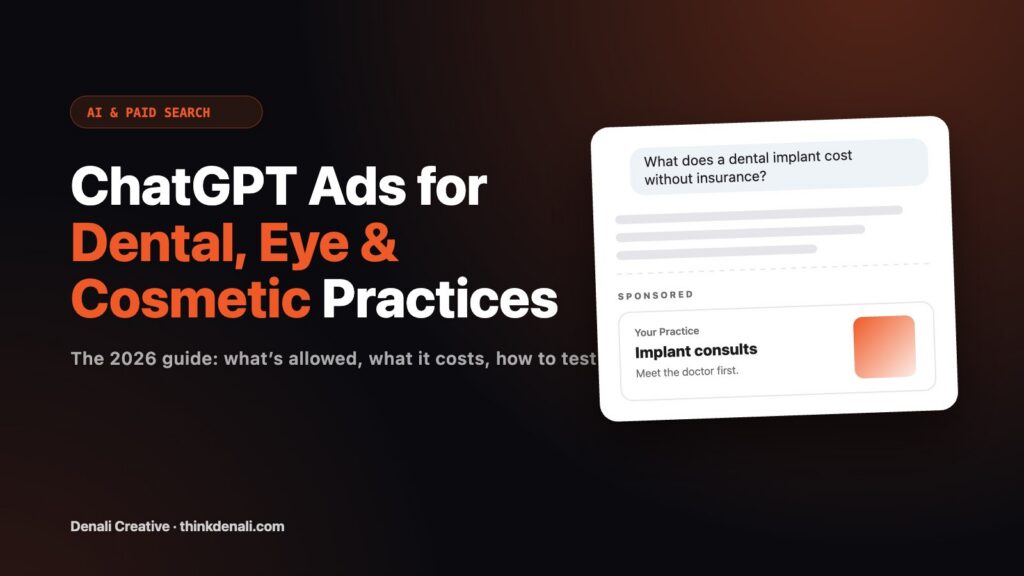
ChatGPT ads do not look or behave like Google Ads. The ad shows up after ChatGPT finishes answering, in a separate, labeled unit. The answer itself is not for sale.
A few rules shape everything else:
- The ad sits below the answer. OpenAI says ads are clearly labeled and do not influence what ChatGPT says. You cannot pay to be the practice ChatGPT recommends.
- Not everyone sees ads. They show to adults on the Free and Go plans. Plus, Pro, Business and Enterprise subscribers do not see ads, and neither do users OpenAI predicts are under 18.
- There are no keywords. You write "context hints" — plain-language descriptions of the conversations you want to appear next to. OpenAI uses them as guidance, not a guarantee.
- No ads on personal health conversations. OpenAI keeps ads out of mental and personal health conversations. Someone describing symptoms may not see your ad. Someone comparing options, prices or providers is a better target.
- The creative is small. Each ad is your practice name, logo, a short headline, a one-line description, an image and a landing page. The landing page has to do the selling.
- Health ads are U.S. only and approved case by case. OpenAI may ask for proof of licensure.
What each specialty can advertise
OpenAI's policy restricts ads for regulated medical services and treatment claims, then carves out approved categories. It also prohibits "invasive or high-risk medical procedures," unsupported treatment claims and experimental therapies. OpenAI has not published a list of which procedures count as invasive, so some of what follows is my read of the policy, not an official ruling.
| Practice type | Likely approved | Gray area | Likely declined |
|---|---|---|---|
| General & cosmetic dentistry | Yes New-patient exams, cleanings, whitening, Invisalign, emergency visits, implant consults | Full-arch implant surgery offers | Guaranteed results, "pain-free" claims |
| Optometry | Yes Eye exams, glasses, contacts, dry eye care, myopia management | Treatment-claim language | Unsupported cure claims |
| Ophthalmology & LASIK | Yes Comprehensive exams, candidacy consults | Maybe LASIK, SMILE, ICL, premium cataract surgery | Experimental procedures |
| Med spa & dermatology | Yes Neurotoxins, fillers, laser and skin treatments | Weight-loss programs | Unapproved products |
| Plastic surgery | Yes Non-surgical services | Consultation-only offers | Unlikely Facelifts, augmentation, liposuction |
ChatGPT ads for dentists
Dental services are named outright, which makes dentistry the clearest fit right now. The best offers are the ones patients research before they call: implant consultations, Invisalign, same-day crowns, whitening, emergency visits and new-patient exams. Keep the copy factual. No guaranteed results, no "pain-free" promises, no before-and-after claims you cannot support.
ChatGPT ads for LASIK, cataract and eye care practices
"Vision products and services" covers eye exams, contacts, glasses and dry eye care. Surgery is less clear. Because OpenAI has not defined "invasive," LASIK, SMILE, ICL and premium cataract surgery may be judged one at a time in review. Plan for that. Lead with the free consultation or candidacy exam rather than the surgery itself, and have a second ad ready if the first is declined. For refractive practices, the consult is the conversion anyway.
ChatGPT ads for med spas and plastic surgeons
Minimally invasive cosmetic procedures — neurotoxins, fillers, lasers, skin treatments — are allowed. Surgical procedures such as facelifts, breast augmentation and liposuction sit much closer to the "invasive or high-risk" exclusion. A plastic surgery practice should test with its med spa and non-surgical services first and send those patients into the surgical consult from there.
You cannot buy the recommendation inside the answer. You can only buy the spot underneath it — so the answer has to be earning you trust already.
Example context hints and ads by specialty
Context hints are where most of the skill is. Write them the way patients actually talk: specific, in full sentences, focused on decisions rather than symptoms. Here are the kinds of conversations I would build ad groups around.
Dental
- Someone comparing the cost of dental implants with and without insurance
- An adult deciding between Invisalign and traditional braces
- A person looking for a dentist who sees new patients this week
Eye care
- Someone over 40 asking whether LASIK still makes sense or if they should wait for cataract surgery
- A contact lens wearer comparing LASIK, ICL and SMILE
- A person looking for a dry eye specialist
Cosmetic
- Someone asking how long Botox lasts and how often people go back
- A person comparing filler and laser treatments for fine lines
- Someone planning skin treatments before a wedding or event
And here is what compliant ads could look like. The practice names are fictional.
Notice what these ads do not do. They do not promise results, they do not mention symptoms, and every one of them offers a clear next step a patient can take today.
What ChatGPT ads cost
There is no minimum spend. When OpenAI opened Ads Manager, it removed the $50,000 minimum that applied to the early pilot. You can bid two ways:
- Cost per click (CPC). OpenAI suggests a starting maximum bid of about $3 to $5 per click. For most practices this is the right choice, because you only pay when someone visits your page.
- Cost per thousand impressions (CPM). The original pilot model, around $60 per thousand impressions. Better suited to large brands buying awareness than to a practice that needs booked consults.
Watch the defaults. When we set up accounts, Ads Manager suggested an average daily budget of $100 — about $3,000 a month — with a "Maximum results" bid strategy and no per-click cap. That is too much for a first test. At the time of writing, OpenAI is also offering $500 in ad credit when a new account spends $500 within 14 days of the promotion being attached, so a test of about $36 a day for two weeks clears that bar.
A click is not a patient. The number that matters is cost per booked consultation, and you will only know it after a test. In our experience the best way to judge it is against what Google Ads already costs you for the same service.
How to set up ChatGPT ads for your practice
Setup takes an afternoon. Approval can take longer, especially for health categories. Here is the order I follow.
Have the practice create the account
The practice signs up at ads.openai.com under its own business, then invites its marketing agency as a team member. OpenAI's setup guide says agencies creating advertiser accounts on a client's behalf are not supported (OpenAI Help).
Get the locked settings right
Country, currency and time zone cannot be changed after the account is created. Set the time zone to where the practice is, not where the person setting it up sits.
Verify the business and licensure
Business verification runs through OpenAI's identity partner, and health advertisers go through manual review. OpenAI may ask for proof of licensure, so have license numbers and the legal entity name ready. Upload your logo, which appears as the small icon on every ad.
Set up billing
Add the billing contact, invoice email, address and a card. Campaigns will not deliver until every setup step is complete and the account is approved.
Build the campaign
Set the objective, daily budget and dates. For a first test, use one campaign and split services into ad groups — implants, Invisalign, LASIK consults — so you can read results by service.
Write context hints in ad groups
Each ad group gets its own set of context hints. Group them by patient situation: price research, comparing options, ready to book.
Write two or three ads
Short headline, one-line description, a real photo of your office or team (not your logo), and a landing page built for that service.
Set up tracking carefully
Install the pixel only on pages that do not collect health information, and track a neutral conversion event. More on this below.
Launch and watch the first week
Check that ads are approved and delivering. If a surgical ad is declined, switch to the consultation version.
What we saw setting up ChatGPT ads for two practices
We opened Ads Manager for two practices we manage: a LASIK group with three offices in New York City and a cosmetic dental practice in Dallas–Fort Worth. Neither campaign is live yet. Here is what the setup looked like and what we would change before spending a dollar.
OpenAI writes the first campaign for you
After you enter your website, Ads Manager scans it and builds a recommended campaign: an ad, a budget, a bid strategy and the conversation themes it plans to target. For the dental practice it chose two themes on its own, roughly "people in [city] looking for cosmetic dentistry and smile makeovers" and "adults considering veneers, teeth whitening, or clear orthodontics." For the LASIK practice it wrote "LASIK in NYC — Explore vision correction with [practice name]."
That is a fast start, but it is a draft, not a strategy. The dental draft included clear orthodontics, a service that practice deliberately does not advertise. Read every theme before you accept it.
| Setting | OpenAI's draft | What we changed it to |
|---|---|---|
| Locations | United States | The practice's metro area, if the option is available. Otherwise a smaller budget. |
| Daily budget | $100 average per day | About $36 per day for a 14-day test |
| Bid strategy | Maximum results | A $3–$5 per-click cap where offered |
| Objective | Clicks | Clicks (fine for a test), judged on booked consults |
| Ad image | The practice logo (LASIK) and a generic operatory (dental) | Real photos of the doctor, team and office |
| Targeting themes | Pulled from the website, including services the practice doesn't promote | Rewritten by service, decision-stage only |
| Time zone | The time zone of the person signing up | The practice's own time zone (locked after creation) |
Three things to get right before you continue
- Who owns the account. The practice, not the agency. Agencies get invited as team members.
- Country, currency and time zone. All three are permanent once you click "Continue to billing."
- Whether your landing page matches your offer. Not permanent, but reviewers check it. If the ad promotes a discount, the page has to show the same discount with the same expiration date.
Advertising services and writing custom ads
Two questions we hear most: can a practice advertise specific services, or only the practice itself? And can you write your own ads, or are you stuck with what OpenAI generates? The answer to both is yes, you have control.
You can advertise specific services
Each ad has its own headline, description, image and landing page. Ad groups are organized around one theme each, with their own context hints. That means a cosmetic practice can run separate ad groups for veneers, smile makeovers and whitening, and a LASIK practice can split LASIK, SMILE, EVO ICL and over-40 vision correction — each sending patients to the page for that service. The service still has to fit an approved category, which is why we lead surgical services with the consultation.
You can write your own ads
The suggested ad is a starting point. Click Edit and you can rewrite the headline and description, swap the image and change the destination. You can add more ad groups and ads in the guided flow, or build a whole campaign at once with OpenAI's bulk-upload template. OpenAI has not published hard character limits, so we keep headlines under about 30 characters and descriptions under about 70, which fits the ad card without getting cut off.
How we structure a practice's first ChatGPT campaign
- One campaign per practice for the test, with a fixed budget and end date.
- Three to five ad groups, one per service, each with three or four context hints written as patient situations.
- Two ads per ad group: one that leads with the doctor or credentials, one that leads with a low-commitment offer like a free consult or smile preview.
- One approval-friendly ad group for practices with surgical services — dry eye care or eye exams for a LASIK group — so the account keeps running if a surgery ad is declined.
- A dedicated landing page per service, with the same offer and wording as the ad.
What a ChatGPT ad landing page needs
Someone clicking from ChatGPT has usually just read a detailed answer. They are informed and comparing. Your homepage will not convert them. A dedicated page for the service will.
Landing page checklist
- A price range or financing options. Cost is the most common question in these conversations. Answer it.
- The doctor's name, photo and credentials. Board certification, years in practice, number of procedures.
- Reviews from real patients for that specific service.
- A short FAQ that answers the same questions people ask ChatGPT.
- A short form and a click-to-call button — no more than name, phone, email and preferred time.
- Matching language. If the ad says "candidacy exam," the page should say "candidacy exam."
HIPAA and tracking: the part practices can't skip
ChatGPT Ads Manager offers a tracking pixel and a Conversions API so you can see which clicks turn into appointment requests. This is where healthcare practices get into trouble on every ad platform, not just this one.
In 2022, the HHS Office for Civil Rights warned that tracking technologies on healthcare websites can disclose protected health information. A federal court narrowed that guidance in 2024 for public, unauthenticated pages, but pages where patients log in, schedule or fill out forms are still the risk zone. The safest approach is to keep ad-platform tracking away from anything a patient types.
My rules for any practice testing ChatGPT ads:
- Do not place the pixel on patient portals, scheduling tools or forms where a patient describes a condition or treatment.
- Track a neutral event, such as a thank-you page that does not name the service.
- Do not send names, emails or phone numbers to OpenAI unless your compliance advisor has reviewed it.
- Count results in your own system: booked consultations in your practice management software or call tracking, not platform clicks.
None of this is legal advice. Run it past whoever handles HIPAA for your practice before the pixel goes live.
ChatGPT ads vs. Google Ads for practices
ChatGPT ads are not a replacement for Google Ads. They reach patients at a different moment, and they are much less mature as a platform.
| ChatGPT ads | Google Ads | |
|---|---|---|
| How you target | Context hints describing conversations | Keywords, locations, audiences |
| Where the ad shows | Below ChatGPT's answer | Search results, Maps, AI Overviews, YouTube and more |
| Who sees it | Adults on Free and Go plans | Nearly everyone who searches |
| Patient mindset | Researching and comparing | Often ready to book now |
| Local targeting | Limited compared to Google | Precise radius and ZIP targeting |
| Healthcare rules | Short approved list, case-by-case review | Established healthcare policies and certifications |
| Track record | Months | Over 20 years |
For most practices, Google Ads stays the main paid channel and ChatGPT becomes a test budget. That may change as OpenAI adds features, but it is where things stand today.
Google AI Mode and other AI ad platforms
ChatGPT is not the only AI platform selling ads. Here is where each one stands for healthcare practices right now.
Google AI Mode
In June 2026, Google's Ads Liaison confirmed "a small test of ads in AI Mode for the healthcare vertical" in the U.S. for English searches (Search Engine Roundtable). There is no separate signup. Ads come from existing Performance Max, AI Max, Shopping and broad match campaigns, and the first version of the test excludes ads that use pinned assets or text disclaimers.
That matters for practices because Google started moving eligible Search campaigns to AI Max in September. If your Google Ads account uses broad match, your ads may already be eligible to show in AI Mode as the test expands. Review your negative keywords and pinned headlines now.
Microsoft Copilot
Microsoft has run ads in Copilot for some time through Microsoft Advertising, with recent formats focused on retail. If you already run Microsoft Ads, your search ads may appear there. It is a smaller audience than Google or ChatGPT.
Perplexity
Perplexity announced in early 2026 that it is phasing out ads, citing user trust (Campaign). For practices, Perplexity is an organic visibility channel, not a paid one.
A 30-day ChatGPT ads test plan
Week 1: Pick one service with clear demand and a clear price point — implants, Invisalign, LASIK consults or neurotoxin. Build one landing page for it using the checklist above.
Week 2: Set up the account, verify the business and upload proof of licensure if asked. Write five to ten context hints and two or three ads. Set up conservative tracking.
Weeks 3–4: Spend a fixed test budget you are comfortable losing. About $36 a day for 14 days comes to roughly $500, which also qualifies for OpenAI's current $500 credit offer. If you want more data, go to $1,000 to $1,500, still at $3 to $5 per click.
Day 30: Count booked consultations, not clicks. Compare the cost per booked consult to what Google Ads costs you for the same service. If ChatGPT is within range, keep going. If not, stop and check again in a quarter.
Who should wait
ChatGPT ads are not the first dollar for most practices. I would hold off if:
- Your Google Business Profile, reviews and Google Ads are not already producing booked patients. Fix the proven channels first.
- Your front desk is not converting the calls you already get. More leads into a leaky phone process just costs more. Our dental phone training guide covers this.
- Your main offer is a surgical procedure that may not clear review. Test consult or non-surgical services first, or wait for the policy to settle.
- You do not have a landing page for the service. Sending ChatGPT clicks to your homepage wastes the test.
Ads are the second layer, not the first
The bigger shift is still the organic answer. When a patient asks ChatGPT who the best cataract surgeon in their city is, the practices named in the answer get the call — and no ad budget buys that placement. Your ad will appear under an answer that either mentions your practice or mentions your competitor.
That is why we treat AI visibility and AI advertising as one plan. The work that gets a practice named in AI answers — accurate listings, strong reviews, clear service pages, real doctor credentials — also makes the ad more believable when it shows up underneath. If you have not looked at that side yet, start with why your practice isn't showing up in AI search, then read what to measure in AI search now and 10 ways AI can change an ophthalmology practice.
Frequently asked questions
Can a dental practice advertise on ChatGPT?
Yes. Since OpenAI's July 2026 policy update, dental services are an approved health category for U.S. advertisers. Ads are reviewed case by case, and OpenAI may ask for proof of licensure.
Can LASIK or cataract surgery practices advertise on ChatGPT?
Possibly. Vision products and services are an approved category, but OpenAI prohibits ads for invasive or high-risk medical procedures and has not said exactly which surgeries fall under that. Lead with eye exams or candidacy consultations and expect surgical offers to be reviewed individually.
Can med spas and plastic surgeons advertise on ChatGPT?
Med spas can advertise minimally invasive cosmetic procedures such as neurotoxins, fillers and laser treatments. Surgical cosmetic procedures are likely to fall under OpenAI's ban on invasive or high-risk procedures, so plastic surgery practices should start with their non-surgical services.
How much do ChatGPT ads cost?
There is no minimum spend. Ads Manager supports cost-per-click bidding, with a suggested starting bid of $3 to $5 per click, and cost-per-thousand-impressions bidding at around $60 per thousand.
Who sees ads in ChatGPT?
Adult users on ChatGPT's Free and Go plans. Plus, Pro, Business and Enterprise subscribers do not see ads, and OpenAI excludes users it predicts are under 18. Health ads are limited to the U.S.
Can I pay to be recommended in ChatGPT's answers?
No. Ads appear below the response and are labeled. OpenAI says ads do not influence ChatGPT's answers. Being named in the answer depends on your practice's reviews, listings, website content and reputation.
Do ChatGPT ads show during health conversations?
Not during mental and personal health conversations. OpenAI keeps ads out of those. Ads are more likely to appear when someone is comparing options, prices or providers.
Are ChatGPT ads HIPAA compliant?
That depends on how your practice sets up tracking. Keep the pixel off patient portals, scheduling tools and forms where patients share health information, track only neutral conversion events, and have your compliance advisor review any data you send to the platform.
Are ChatGPT ads better than Google Ads for a practice?
Not today. Google Ads reaches more people, has precise local targeting and a long healthcare track record. ChatGPT ads are worth a small, measured test, judged on cost per booked consultation compared with Google Ads.
Can a marketing agency set up ChatGPT ads for a practice?
An agency can manage the ads, but the practice should create the advertiser account. OpenAI's setup guide says agencies creating advertiser accounts on a client's behalf are not supported. The practice signs up, completes business verification and billing, then invites the agency as a team member.
Can I advertise specific services on ChatGPT, or only my practice?
Specific services. Each ad has its own headline, description, image and landing page, and ad groups are built around one theme each. A practice can run separate ad groups for veneers, whitening, LASIK consultations or EVO ICL, as long as each service fits OpenAI's approved health categories.
Can I write my own ChatGPT ads?
Yes. Ads Manager drafts an ad by scanning your website, but you can edit the headline, description, image and landing page, add more ad groups and ads, or upload a full campaign with OpenAI's bulk-upload template.
What settings can't be changed after creating a ChatGPT ads account?
Country or region, billing currency and time zone are permanent once the advertiser account is created. Set the time zone to the practice's location before continuing to billing.
Does Google show ads in AI Mode for healthcare?
Google began a small test of healthcare ads in AI Mode in June 2026, limited to U.S. English searches. Ads come from existing Performance Max, AI Max, Shopping and broad match campaigns rather than a separate signup.
Should your practice test ChatGPT ads?
We'll look at your services, your current Google Ads costs and your AI search visibility, and tell you whether a test is worth it — and what to test first.
Book a strategy call →